AI operating system for founders
Stop being the bottleneck. Build your own AI operating system.
Your company does not need more of your hours. It needs your judgment, systematized. A second brain you own, a brief every agent reads first, and supervised agents that take the repetitive work off your desk.
The founder's trap
You are the most expensive connector in your company
Every quote, every decision, every follow-up, every quick question still passes through you. Your knowledge is scattered across chat threads, documents, WhatsApp, and spreadsheets. You use ChatGPT reactively: open a blank chat, re-explain your business, get something generic, then spend more time fixing it than it saved. Nothing compounds. You end the week busy, and unsure what actually moved.
It is not a discipline problem. It is a system problem. When nothing holds your context, every task starts from zero, and you are the only one who can connect the pieces.

You are the memory, the dispatcher, and the quality check. Every recurring task lands on your desk again. The AI you pay for does not know your clients, your prices, or your voice, so you keep explaining yourself to a blank window.
Your context lives in your files. Agents read your second brain and your brief before they act. Recurring work becomes an SOP. Automations handle the routine parts and stop at the decisions that need you. Your hours go back to selling, building, and thinking.
The complete system
The whole thing on one map
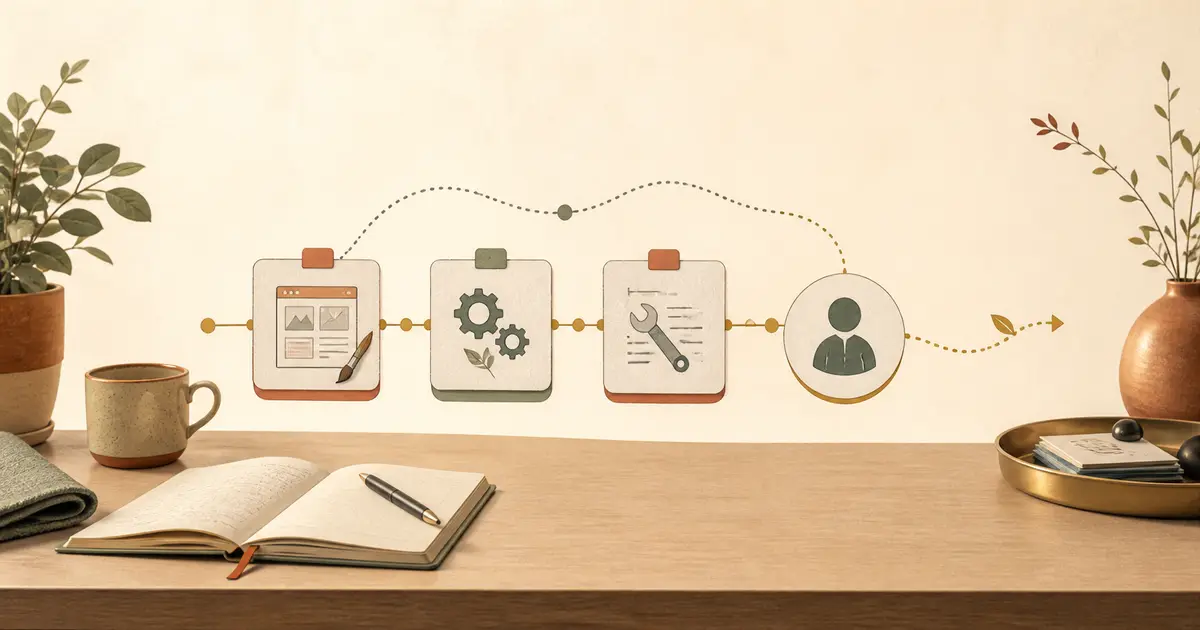
Everything we build fits into one pipeline. Each stage feeds the next, and the loop compounds: the better your second brain, the better your agents perform, and the more useful their output, the more worth it is to keep feeding the system.
Export your AI data
Pull what ChatGPT, Claude, and other tools already know about you. Your context should not start from zero.
Second brain
Organize that knowledge into plain files you own: searchable, linkable, and ready for any agent to read.
AGENTS.md
The short brief every agent reads first. Who you are, how you work, what to always do and never do.
AI agents
Agents that read your context and act on your behalf: research, drafting, follow-ups, small internal tools.
SOPs
Your recurring processes, written clearly enough that an agent can run them without you in the room.
Automations
SOPs that run with little or no supervision, and stop at the decisions that genuinely need you.

The loop is the point
A system you feed once and forget is just a fancy prompt. A system you keep feeding gets sharper every week, because your agents inherit everything you have already figured out. That is why this is a habit, not a one-off setup.
In practice
The same week, with and without a system
The difference is not the model. It is whether the model has your context and whether the work you repeat gets written down.
| Founder with a chatbot | Founder with a Codex | |
|---|---|---|
| Context | You re-explain your business in every new chat. | Agents read your second brain and brief automatically. |
| Output | Generic, and you spend more time editing than it saved. | Specific to your clients, prices, and voice. |
| Memory | Locked inside a vendor. Hard to see, search, or export. | Plain files you own and can take anywhere. |
| Recurring work | You do it again, by hand, every week. | Written once as an SOP, then run by an agent. |
| Your time | Lost connecting tools and copying data between tabs. | Spent deciding, selling, and building. |
| AI model | Tied to one provider and their roadmap. | Switch models freely and keep your setup. |
What you take home
Five assets that stay in your business
You do not leave with theory or a to-do list. You leave with things that keep working after the sessions end.
A second brain you own
A growing base of your knowledge, clients, decisions, and methods, stored in plain files that outlive any tool.
Your AGENTS.md
One short brief that turns a generic assistant into one that already knows how you work before you type a word.
A working agent
At least one agent running on your real work, not a demo. It reads your context and produces something you can use.
Your SOP library
The recurring tasks you dislike, written once so an agent can run them and you can stop being the connector.
Autonomy and the method
The D.A.D.+V habit (Delete, Automate, Delegate, Validate) to decide what to keep, what to hand over, and what to never hand over.

Own your context
Your context is the valuable part. Keep it yours.
- Vendor memory is opaque. You cannot search it, organize it, or take it with you. Your second brain is plain text: searchable, editable, portable.
- Models change. Context compounds. Because your setup lives in your files, you can switch to a better, cheaper, or more private model without rebuilding anything.
- It matters legally too. In Europe, GDPR restricts sending customer data to many US AI providers without the right agreements. Keeping context in your own files keeps that decision in your hands.
Why now
The agent wave will not catch itself
ChatGPT spread faster than any software in history because it was familiar: you asked a question, you got an answer. Agents are different. They act on your behalf, connect to your tools, and change your files. That is more powerful, and it takes deliberate learning and new habits. Most founders have not caught this wave yet, not because they are not smart, but because it is genuinely new.
Waiting is not neutral. It compounds. Someone who starts today is not one month ahead of someone who starts next year. They are one month of compounding ahead, and the gap widens. While you wait, the repetitive work still lands on your desk, and the advantage someone else is quietly building gets harder to close.
The one action: leave with your second brain started and one agent running. Momentum beats perfection.
How it works
Three steps, on your real work
Map your week
One call. We find the most expensive bottleneck: the task or decision that only you can do, and should not.
Build the system
Your second brain, your AGENTS.md, and your first agent running on a real task, not a sandbox exercise.
Hand it over
You and your team can run and extend it without an agency, and without us. The system is yours to keep.

"It feels like you are a year ahead of everyone else"
Flore runs a training and design business. Like most founders, she carries many fronts at once and does not code.
"I have to carry so many things at once. With the second brain, it feels like you are a year ahead of everyone else. I am not a programmer, but I have built complete automations and my own tools. The AI has the full context of my business and works in the background while I do something else. My client files stay on my own computer, with privacy and no legal risk. Everything is far more fluid."
Who builds this with you
Samuel Michelot, engineer and founder
Software engineer since 2006. Founded MosaLingua, a language-learning app used by millions, and sold it. Creator of YAIBOS, an open specification for sovereign AI business operating systems. Using AI agents daily since late 2024, and running several projects in parallel with them.
1 week
to connect his second brain to agents and feel the shift
50 videos
edited and ready to publish, plus 3 channels launched
4 websites
and dozens of articles, built from notes that had sat unused
That is the honest version: he was already using agents for development every day, so your first boost will take longer. But it is the same system, and it is teachable.
✓ This fits you if:
- •You are a founder or owner of a small business (roughly 2 to 50 people) and too much still depends on you.
- •Your knowledge and processes live in your head, in chat threads, or scattered across tools.
- •You want to use AI as a system, not as a toy you re-explain every time.
- •You can give it a few focused hours a week, and you want something that pays back every week.
- •You want to own your data and stay free to change tools and models.
✕ This is not for you if:
- •You want to hand everything to an agency and never think about it again.
- •You want a course of ChatGPT tricks that changes nothing about how you work.
- •You are looking for a magic button that runs the business without you.
- •You are not willing to write down how you work, even roughly.
Frequently asked questions
The questions founders ask first
What is a "Codex", and why that name? +
Your Codex is your personal AI operating system: the combination of your second brain, your AGENTS.md brief, and the agents that run on your context. It is a way of working, not a product you rent from a vendor. The name is a nod to a codex as a bound set of knowledge that belongs to you.
Is this just using ChatGPT with extra steps? +
No. A chatbot waits for you to re-explain everything in a blank window and forgets between sessions. A system already holds your context, so agents start from your clients, your prices, and your voice. The difference is that the work compounds instead of resetting every time.
Do I need to be technical? +
No. Everything lives in plain text files and simple tools you already understand. The skill you build is describing work clearly and checking the result, not coding. If you can explain a process to a new employee, you can build this.
What can an agent actually do for a founder? +
Bounded, verifiable work: draft quotes or proposals, summarize meetings, follow up on leads, clean and reformat data, build small internal tools, prepare a weekly review, or generate reports from a template. Start with tasks where a mistake is cheap to undo.
Where does my data live, and is it safe? +
In your own files, on your own machine or storage. You decide what an agent can read. Sensitive material can stay in a separate private space, or never leave your computer. Unlike vendor memory, you can see, search, edit, and delete everything.
Will this lock me into one AI provider? +
The opposite. Because your context lives in your files, you can switch models when a better, cheaper, or more private one appears, and keep your whole setup. The model will keep changing. Your context is the part that is yours.
How much time does it take? +
A few focused hours to start, then a small weekly habit. The point is to spend less time on repetitive work than you do today, not to add a new hobby. We build it on your real work so it pays back from the first week.
How do I start? +
With one call. We map your week, find the most expensive bottleneck, and build the first pieces of your system on a task you actually do. You leave with something running, not with a plan.
Build your operating system
Let's talk about the task that only you can do, and should not. One call, and you leave with the first piece running.